This blog concerns the injustice of class warfare being waged against us globally by the top 1% and what the Bible has to say about it. The cadre of bankers, Wall St. money brokers and their Washington lobbyists, who have brazenly hijacked the American government and its monetary system, will not return the power they have taken away voluntarily. Are you ready for revolution? Are we even going to need any guns? This follower of Jesus doesn't think so!
Showing posts with label hunger. Show all posts
Monday, February 18, 2019
Sunday, January 27, 2019
The Solution to the Shutdown Was There All Along. Trump and Congress Both Ignored It.
Our
Civics Lesson for This Week, or, Why Adults
Having
Temper Tantrums Should Check Themselves
by
Minister Paul J. Bern
To view
this on my website, click
here :-)
The
first thing I'd like to say this week is 'thank God the shut-down is
over', or at least for the next three weeks. As
I wrote a month ago, holding hostage the paychecks of some 1.2
million people is no way to run a country. Although I admire the way
president Trump has refused to go along with the status quo inside
the Beltway, especially his opposition to the Deep State, this time
around Trump made a serious miscalculation by shutting down the
government. Keeping it shut down for five weeks and traumatizing
hundreds of thousands of federal workers and their families has
compounded his miscalculation. Like the Rolling Stones used to sing,
“You can't always get what you want”.
The
Bible has some very relevant teachings regarding this very topic. For
one thing, angry or selfish people are troublemakers by nature, as it
is written: “Fools
give full vent to their rage, but the wise bring calm in the end.”
(Proverbs 29: 11) As you can see from these words of King Solomon,
people who get angry when they don't get what they want are unwise at
best, and toxic people at worst. Hear that, all you politicians,
especially those inside the Beltway? By pitching a fit, throwing a
temper tantrum or collectively holding their breath until they die
(Go ahead! Be my guest!), or at least for as long as they could, our
nation's leaders have proven themselves unworthy of the offices to
which they have been elected. With the 2020 elections looming, every
one of them, from Donald Trump on down across both sides of the
aisle, has just under a year to get their acts together and learn to
work with each other. Otherwise the American electorate will not put
up with it.
What
else does the Bible have to say about people who let their anger get
the best of them? “An
angry person stirs up conflict, and a hot-tempered person commits
many sins.”
(Proverbs 29: 22) Have you ever noticed how uncompromising people
operate? 'It's my way or the highway', they will quickly tell anyone
within earshot. Have you also noticed they are the ones who seem to
get the least done? They are so busy trying to coerce others into
doing their bidding that they wind up spinning their own wheels. In
the case of the US government shutdown, president Trump ended up
spinning his wheels too. Had president Trump tried a more
conciliatory approach to get his border wall, he could have achieved
different results, as it is written: “A
gentle answer turns away wrath, but a harsh word stirs up anger.”
(Proverbs 15: 1) If Donald Trump had not taken his usual 'my way or
the highway' approach, like he is evidently prone to do when running
his real estate empire, the government shutdown may have not ever
occurred.
There
seems to be quite a bit of this sort of problem throughout America's
government. I have observed too much tit-for-tat politics, too much
infighting and squabbling, and a heck of a lot of lying, for me to
take the federal government seriously anymore. It's also been my
observation that an ever-increasing number of Americans feel the same
way. What America, and particularly her lawmakers, need to do is call
a cease fire long enough to read the following portion of 1st
Corinthians: “4)
Love is patient, love is kind. It does not envy, it does not boast,
it is not proud. 5) It does not dishonor others, it is not
self-seeking, it is not easily angered, it keeps no record of wrongs.
6) Love does not delight in evil but rejoices with the truth. 7) It
always protects, always trusts, always hopes, always perseveres.”
(1st
Cor. 13, verses 4-7)
Love,
love in Washington? Yeah, because there's a complete absence of it as
I write this. While the fight between all the 'my way or the highway'
Democrats and Republicans raged on, 1.2 million federal workers came
within days of eviction or the commencement of foreclosure
proceedings. Seriously, all these people were on their way to being
homeless, many with families to look after, and all the combined 462
members of Congress, together with the President, could do was invent
more ways to disagree. Even now, the reopening lasts for only three
weeks. These people had better get their acts together, or there will
be pandemonium in the streets of America. But to get back to the
above Scriptural quotation, Washington has far too little patience
and far too little kindness, while having an excess of corruption,
arrogance, boastfulness and pride.
Washington
has dishonored those they are elected to serve with their childish
behavior, unlike verse 5 above. Instead of looking out for the
interests of the people, Washington is and has been self-seeking.
Verse 5 also says that true Christian love should not be easily
angered. Yet by shutting down part of the government so he could get
his way, president Trump has violated this very Scriptural premise.
“Love keeps no record of wrongs.” Hear that one, Congress? You
people need to stop sparring with each other, grow up, and take care
of America's business. Otherwise the whole country will wither away
while our 'representatives' and the president are busy bickering like
children. “Love....rejoices
with the truth.”
You
know, a heavy dose of some truth is what the American people would
really like to hear right about now. We want to know the truth about
the triple assassinations of the Kennedy brothers and Rev. Dr. King,
about the Gulf of Ton-kin incident, about 9/11, and about the start
of the 2003 Gulf War. We want the truth about the true extent of the
US military-industrial complex, about whether UFO's are actually a
secret technology developed by the military or if they are truly
alien, and about Antarctica. We want the truth about the
currently-mandatory vaccines, the level of corruption in law
enforcement and the courts, and the dangers of the pesticides that
are being sprayed on all our crops. The American people are
collectively so fed up with all the BS in Washington, and throughout
the country including our most respected institutions, that there is
open talk of civil war all over social media.
“Love
always protects.” The whole country was left unprotected during the
shutdown, so Trump and Co. missed the mark on that one. “Love
always trusts”, yet Congress and the President mistrust each other
to this day while the rest of the country goes to pot. “Love
always hopes, always perseveres.”
For about 35 days, up until this past Friday, there was a complete
absence of both of these in Washington. Congress and the President
are equally to blame for the shut-down as far as I'm concerned. Their
combined lack of good character, patience, perseverance and
even-temperament is the reason this shut-down occurred.
Congress
and the President have been unkind, untruthful and arrogant, they
have gone to great lengths to keep score against one another, and in
so doing they have made themselves unworthy of their elected office.
It's too early to tell whether this recently-ended shut-down will
affect the 2020 elections. But if a second shut-down occurs 3 weeks
from now, it could have repercussions that last well beyond 2020. In
that event, the likelihood of a third-party candidate emerging to win
the presidential election in November 2020 will increase by a factor
of two or more. Stay tuned, people, this may get really interesting.
Unless Trump furloughs the same 1.2 million people as before in 3
weeks time, and tries to compel a portion to return to their duties
unpaid, in which case all hell could break loose.
Sunday, December 9, 2018
My 7 Reasons Capitalism is Done and Over With (with free book excerpt)
Seven
Reasons Why Capitalism,
As We
Know It, Has Run Its Course
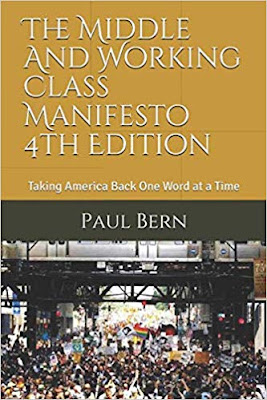
Free book
excerpt #33 from, “The
Middle and Working Class Manifesto 4th Edition” by Rev. Paul J.
Bern
For a
website view, click
here :-)
As
world trade continues its anemic 1.2% average annual growth rate,
politicians in most industrial countries, and particularly in the US,
have an incentive to make exaggerated claims about the alleged
ongoing economic recovery. The government wants us to think the Great
Recession is over, and that we're on "the road to recovery,"
while the American people and other nations look on skeptically. The
ugly truth is that more and more people have lost confidence in –
and consequently no longer trust – the federal government. To make
matters worse, 2015 turned out to be the year when the American
public lost confidence and trust in law enforcement (think Michael
Brown in Ferguson, Mo., and Eric Gardner in New York, and that's just
for starters). The street protests in Ferguson, New York, Chicago,
L.A., Atlanta, Baltimore and elsewhere attest to the authenticity of
that mistrust, which continues to get progressively worse. Below are
seven important social phenomena that point to a more realistic
economic and political outlook for 2019. Let's start where it matters
most by beginning with the economy.
My
Seven Reasons Why Capitalism Can't Recover
1)
The Central Banks are clueless. The usual tricks that U.S. and
European central banks use to keep their debt-based economies going
are long-exhausted. Interest rates cannot get much lower. And because
cheap money wasn't working, the printing press was turned up a notch,
into what the U.S. federal reserve calls quantitative easing --
injecting hundreds of billions of dollars into the world economy,
escalating an emerging trade war. Most recently, the Fed is raising
rates at the insistence of investors and retirees, who have been
seeing zero income from their “investments” for many years. This
is bound to end disastrously one way or the other.
2)
Trump's Trade Wars. For a global economy to grow, global
cooperation is needed. But in a major recession all countries engage
in a bitter struggle to dominate foreign markets so that their own
corporations can export. These markets are won by devaluing
currencies (accomplished in the U.S. by quantitative easing),
installing protectionist measures (so that a nation's corporations
have monopoly dominance over the nation's consumers), or by waging
warfare (a risky but highly effective form of market domination).
3)
The Pentagon's Military Wars.
Foreign war is a good symptom of economic decay. The domination of
markets – every inch of them – becomes an issue of life and death
importance. Wars have been unleashed in Afghanistan, Iraq, Syria and
Yemen. America is fighting scores of clandestine wars in numerous
other countries as well. "Containing" economies like China
and "opening" economies like Iran and North
Korea become more urgent during a major recession, requiring
brute force and creating further global instability in all realms of
social life.
4)
The U.S. Economy is going nowhere in a hurry.
The most important consumer market in the world, the U.S., is a
nation of totally bankrupt consumers. Nearly 18 million Americans are
unemployed or underemployed, while further job losses are certain due
to nearly every state's budget deficit. States are bracing for more
painful cuts, more layoffs, more tax increases, more battles with
public employee unions, more requests to bail out cities. And in the
long term, as cities and states try to keep up on their debts, the
very nature of government could change as they have less money left
over to pay for the services they have long provided." (date
12-05-10; the problem with state government budget shortfalls has
since gotten far, far worse – PB)
5)
Bailout Capitalism Emerges. First
it was the banks and other corporations that needed bailing out in
2008, and now whole nations want the same. Western nations bailed out
their banks by falling into the massive debt that they are now
drowning in. Greece and Ireland have been bailed out, with eyes
shifting to Portugal, Spain, and Italy. With the emergence of
“Brexit”, the entire European Union is being called into question
as the Euro takes a beating in the bailout spree. If the EU is
dismantled, the shock waves will quickly reach other economies
globally.
6)
Bailout Repercussions. All western nations -- starting with the
U.S., Canada and Great Britain – are grappling with their own
national debts. Rich bond investors are demanding that these
countries drastically reduce their deficits, while also demanding
that the deficits be reduced on the backs of working families instead
of rich investors. This is tearing the social fabric apart, as
working and poor people see their social programs under attack. In
Europe mass movements are erupting in France, Spain, Portugal,
England, Greece, Ireland, Italy, etc. Social stability is a
prerequisite for a recovered economy, but corporate politicians
everywhere are asking much more than working people are willing to
give.
7)
The Far Right Emerges. To deal with working people more
ruthlessly, the radical right is being unleashed. In normal times
these bigots yell furiously but no one listens. But in times of
economic crisis they're given endless airtime on all major media
outlets. The message of the far right promotes all the rottenness not
yet eradicated by education: racism, xenophobia, religious
intolerance, violence, and a backward nationalism that fears all
things "foreign." These core beliefs effectively divide
working people so that a concerted campaign against the corporate
elite is harder to wage. Meanwhile, labor unions, progressives, and
other working class organizations are instead targeted.
America
imports twice the dollar amount of manufactured goods than it does
oil. Since 2000 the US experienced a rapid increase in the imports of
advanced technology products. A country dependent on foreigners for
manufactured and advanced technology products is not a superpower.
When it comes to Americans ages
18-24, 63% could not locate Iraq, Iran or Israel on a Middle East
map. Fifty percent could not locate New York City. Moreover, 30% of
respondents thought US
population exceeded one billion. Forty-seven percent of all urban
school children do not possess basic grade level skills. Is there any
doubt as to why the jury system is a sham? Despotism and
dictatorship reign when ignorance and nonsense rule societies.
Society will divide itself into exploiters and exploited. In the
early 1800's, complex literacy in New England exceeded 93%. A small
farm nation, without newly built schools, sport stadiums, and
"prestigious" universities had a much better track record.
They keenly observed the American ideal of independence while never
watching TV or indulging in Virtual Reality.
A
country that has too many lacking in native knowledge is not a
superpower. Countless industrial plants have been closed as 3.5
million jobs in manufacturing have been outsourced in the last ten
years. In that time 7 million less jobs have been created than what
population growth required. The high tech jobs never appeared as
touted. Information Technology, computer system designs, and
telecommunications in fact lost 17%, 9%, and 25% of its work force
respectively. Even wholesale and retail trade experienced job losses,
mainly at the managerial levels. As
several hundred thousand engineers languished in unemployment lines
for years, salaries for law school graduates continue to skyrocket.
Firms in Philadelphia and New York are offering newly trained ruling
class members over $125,000.00 in annual salaries. A country that
does not fully utilize and reward its productive citizens and instead
caters to the parasitic and marginal sectors is not a superpower. A
country whose populace has
been reduced to chattel by the special interest-driven 'health care
for ransom' system is not a superpower.
Unfortunately,
lawsuits for unproven and astronomical monetary amounts are pursued
as the main recourse. These acts obviously fuel the healthcare
crisis. Senator Hillary Clinton, who received $4.6 million from a
trial lawyer group, helped to block medical lawsuit reform during her
2016 campaign. This mild bill would have saved her constituents
$800.00 a year in premiums. A country that allows legalized bribery
to plutocrats to influence law and policy is not a superpower. A
country in which 4-7% of its people are illegals who now choose to
dictate terms is not a superpower. This is clearly a breakdown of law
and order.....”
In
closing, the various reasons for capitalism's impending failure I
have just elaborated on do not happen in a normal economic cycle of
boom and bust. These symptoms point to a larger disease in the
capitalist economic system, a disease that cannot be cured by
politicians who swear allegiance to this deteriorating system and to
the wealthy elite who benefit from it. To ensure that the economic
system is changed so that working people benefit, the ones who do the
real work every day to keep things moving, large-scale collective
action is necessary based on demands that unite the majority of
working people. The ongoing fight for a $15.00 per hour minimum wage
is one good example of large-scale collective action. What America
needs is a massive job-creation program at the expense of Wall
Street, an expansion of Social Security and Medicare, and a
moratorium on home foreclosures. If the Christian community worked
cooperatively with the unions in promoting these demands, working
people could put up a real fight. After all, the Bible says, “The
workman is worth his/her wages”.
Labels:
America,
american empire,
capitalism,
class warfare,
debt,
democracy,
greed,
hunger,
inequality,
injustice,
materialism,
materialistic,
Progressive blogs,
US government
Sunday, November 4, 2018
A Study of the Counterintuitive: It's an Honor to be Poor
Those Who
Are Living Paycheck to Paycheck
Are More
Blessed Than They Realize
by Pastor
Paul J. Bern
To view
this on my website, click
here :-)
I
don't have to explain what's been happening to the US Middle Class
over the last 35 years or so. Many people who used to be Middle Class
in America are now poor. I should know, since I used to make a whole
lot more money than I do now. But that was before the bottom fell out
of everything. I've been there, done that and bought the T-shirt.
Everyone is lamenting because they're living paycheck to paycheck and
they don't know what to do about it. Going to the ballot box, so far,
has produced an exacerbation of America's political problems –
exactly the opposite of what is intended. Now we have people talking
about civil war, and America's citizens are emigrating at record
levels. The ones who are staying are buying guns and ammo at record
levels. No wonder everyone is so tense and on edge!
That's
why the purpose of this week's message is to console those who are
angry and hurt, to counsel those who have been pushed aside or shown
the door without just cause, and to reassure the frightened and
confused. It's not hard to get pretty befuddled about current events.
We live in a world of mass shootings in schools, work places, grocery
stores and even churches – or synagogues, as was the case recently.
Things have gotten so bad that we can't even attend church or go out
for a movie without having to be alert for anyone carrying a weapon.
There is a good side to being poor, and a positive thing about being
oppressed, according to the Word of God (or the Bible, if you
prefer). Allow me to cite a few examples from Scripture.
My
first example is that of the apostle James, who was a very astute
individual, and so his writings are something to take very seriously
regardless of one's religious beliefs – or even a lack thereof.
These words can still be beneficial regardless of faith. “5)
Listen, my dear brothers and sisters: Has not God chosen those who
are poor in the eyes of the world to be rich in faith and to inherit
the kingdom he promised those who love him? 6) But you have
dishonored the poor. Is it not the rich who are exploiting you? Are
they not the ones who are dragging you into court? 7) Are they not
the ones who are blaspheming the noble name of Him to whom you
belong? 8) If you
really keep the royal law found in Scripture, 'Love your neighbor as
yourself,' you are doing right.”
(James 2, verses 5-8)
Take heart if you
are poor or otherwise financially hard pressed! Contrary to what many
think and say, there is no shame in being poor. I was pretty well off
at one time myself, mainly back in the 1990's through most of that
decade, wrapping around to the early 2000's. I know what it's like to
earn a six figure income, and to have to meet a payroll every week.
But those days are gone for good, and there's little I can do about
it except to keep on writing. I live on my small pension check, plus
a little extra each month when I sell a book or two, and I've come to
terms with that. But, what James wrote is even more true today than
back then: “Is
it not the rich who are exploiting you? Are they not the ones who are
dragging you into court?”
The student loan crisis is one modern example of this, foreclosures
are another, and the so-called Drug War is yet another. Over half the
people in state and federal prison are there for nonviolent drug
offenses. America spends entirely too much money locking up all the
wrong people.
“Has
not God chosen those who are poor in the eyes of the world to be rich
in faith and to inherit the kingdom he promised those who love him?”
If you're poor, mentally depressed and running low on hope, then heed
these words of the apostle James, the half-brother of Christ. To say
this another way, it's better to be rich in faith than rich with
worldly goods, and it's better to be poor in worldly goods than it is
to be poor in faith. “If
you really keep the royal law found in Scripture, “Love your
neighbor as yourself,” you are doing right.”
The much-beloved phrase, “Love your neighbor as yourself” is
found first in Leviticus 19: 18, and it was an admonishment from the
Lord Almighty to us all, that there be no hate among us – none at
all! Judging by the racial tensions that simmer all across America,
I'd say we have our work cut out for us as far as loving our
neighbors – regardless of color.
Jesus
himself was more blunt and direct than James in Luke's gospel when he
said: “20)
Looking at his disciples, he said: 'Blessed
are you who are poor, for yours is the kingdom of God. 21) Blessed
are you who hunger now, for you will be satisfied. Blessed are you
who weep now, for you will laugh. 22) Blessed are you when people
hate you, when they exclude you and insult you and reject your name
as evil, because of the Son of Man. 23) Rejoice in that day and leap
for joy, because great is your reward in heaven. For that is how
their ancestors treated the prophets. 24) But woe to you who are
rich, for you have already received your comfort. 25) Woe to you who
are well fed now, for you will go hungry. Woe to you who laugh now,
for you will mourn and weep. 26) Woe to you when everyone speaks well
of you, for that is how their ancestors treated the false prophets.'”
(Luke 6, verses 20-26)
The world's poor,
sick and disabled, Jesus was saying, will be the first through the
gates of heaven. If you hunger, you will be filled by Christ, not by
McDonald's – Jesus guarantees it. Weep all you want for now, Jesus
was saying, because in the end He will give us life and laughter
everlasting. The more people hate you because of me, Jesus was
teaching them, the greater your reward will be. So, let others hate
you just because you will not hesitate to make a stand for Christ.
Never mind Republican or Democrat, conservative, liberal or
progressive – they all pale in comparison to the Spirit of our Lord
and Savior. But in verses 24 and 25, Jesus taught that anyone who
enriches themselves in this life does so at the expense of another,
and those wealthy individuals risk paying an eternal price for being
selfish beyond reason while others went hungry. Verses 24 through 26
could also be interpreted as a prophecy against America, but that
would be another message for another time.
So, I want everyone
reading this who is going through a hard time financially – and
that would be the majority of you – to take heart in their
situation. Granted, you are suffering and miserable, I know how you
feel. But take it from a guy who's been there, you can and will
survive the ordeal you are currently undergoing. If you can't raise
your income, then find ways to cut your expenses. The main thing is
knowing that Jesus is walking beside you in every conceivable way,
every step of the way.
Labels:
capitalism,
debt,
greed,
homelessness,
hunger,
inequality,
poverty,
Progressive blogs,
Rev Paul J Bern,
top 1%,
truth,
unemployment,
US workers,
workers rights,
working homeless
Sunday, October 7, 2018
It's Winter in October for Older American Workers
Winter Arrives Early for
American Workers,
Especially Older Ones
Like Myself
Pastor Paul J. Bern
For a website view, click
here :-)
“....for the worker is worth his/her wages.”
(Luke 10: 7)
“Do not muzzle an ox when it is treading out
the grain.” (Deut. 25: 4)
“Look! The wages you failed to
pay the workmen who mowed your fields are crying out against you. The
cries of the harvesters have reached the ears of the Lord Almighty.”
(James 5: 4)
The US Department of Labor's
announcement on Friday of this week about US unemployment numbers for
September were simply stunning, primarily for their untruthfulness.
Really now, 3.7%, this is what those inside the Beltway expect us all
to believe? Granted, jobs are plentiful, there are no two ways about
it. But this figure is only for those working full time 40 hour per
week jobs. What is being swept under the rug is the huge drop in
wages that has been gradually ongoing for decades. Moreover, those
who are working multiple part-time jobs are not being counted at all.
Neither are those such as myself, who have simply given up looking
for work permanently. America's unemployment rate may well be at
3.7%, but the quality and pay rate for those jobs are abysmal.
In point of fact, due to the
minimum wage here in Georgia where I live being a paltry $7.25 per
hour, many people who work still rely on public assistance, mostly
for groceries and utilities. The minimum wage in over half the
country is still stuck at this level. In a country that bills itself
as the world's richest, a minimum wage of only $7.25 hourly is a
crime against humanity! There are even those who work who are
homeless and living in shelters or with relatives – even sharing
living quarters with strangers. Such is the state of affairs for the
average American worker here in the early 21st century. We
have all been sucked into a whirlpool of debt slavery!
I was among the least fortunate.
After being forced out of IT after the dot-com crash in 2001 I
changed careers, putting myself and my small pickup truck to work as
a contract delivery driver for a local courier company. I did just
fine for over 3 ½ years, and I stayed busy the majority of the time.
But then I suffered a stroke in March 2006, 4 months after my 50th
birthday. Although I did recover from my stroke after a week or two,
I had a hard time handling the heavy boxes of printed matter and
other small freight jobs that were my bread and butter. Then my van
abruptly broke down. It needed an $800.00 fuel pump, and I only had
half that much, so my days as a courier were over. After a 4-month
period of homelessness during the summer of 2006, I managed to
re-enter the technology field I was trained in that I had left 4
years previously.
I had the good fortune of landing a
job as a phone rep working at IBM's main call center in Sandy
Springs, Georgia, an Atlanta suburb. The following year, the agency I
was working for laid off all the oldest people, and I was one of the
first to go. Over the next 6 years, I bounced around from one IT
staffing position to another. All the jobs were temporary, even
though I wanted permanent work. While this was happening, the
frequency of those temporary assignments gradually decreased. By the
fall of 2008, I could only find short-term assignments, and that's
when I ran out of money and unemployment benefits. For the second
time in three years, I found myself homeless and unable to sustain
myself, and this time I was without a car. One day I wandered into a
homeless shelter asking for help, and the next thing I knew I was on
my way to a hospital. It turns out I had double pneumonia, plus blood
clots in my legs, and I had no idea I was in that bad of shape. I was
also suicidal after being homeless and on the street for the previous
three weeks. I was a real mess.
I'm now in my tenth year of
recovery from the gradual but complete collapse of my physical and
mental health from 2006-2008. Personally, I credit my faith in
Christ's healing power for pulling me through. I was diagnosed with
bipolar disorder, chronic depression, and PTSD, not counting my
cardiac issues. I've since learned that recovery from mental health
issues are similar to addiction recovery – I take it one day at a
time. But, as we all know, the first step to any recovery from a
health crisis, whether it be physical, mental or spiritual, is to be
honest enough with ourselves to admit to the existence of the
problem. Only then can one recognize that it is advantageous to find
ways of dealing with one's illness – not only for oneself, but for
all we know or come into contact with.
My original plan once I was
released from the hospital was to get well enough to return to the
workforce, but after being out of the job market for nearly 2 years,
all attempts at obtaining employment in my field – either as a
contractor or an employee – proved fruitless. So I looked into
retraining for a new career as a long haul truck driver, only to be
told that I didn't qualify for financial aid because I had a poor
credit rating due to my unpaid medical bills (I had no insurance when
my stroke occurred). While all this was happening, the bottom fell
out as far as wages were concerned within the IT industry.
Technicians and support personnel like myself who used to make $20-35
dollars an hour are now being paid $10-$12 dollars per hour for
essentially the same work, and that's assuming they're lucky enough
to have a job. Financially speaking, it is a profoundly sad state of
affairs.
But that is only half the story for
myself and for the multitudes of others who suffer various ailments
that are brought on by being under extreme stress. The rest of the
story for nearly all who are managing a physical or mental illness
diagnosis, and especially those who are suffering while not yet
diagnosed, can be summed up in two words: Economic devastation.
During my recovery I discovered that reentering the job market was
nearly impossible for a man in his fifties like myself. After an
additional 1.5 years of searching fruitlessly in my field (I was a
computer/IT pro with a total of 21 years experience), I was forced to
settle for being put on disability instead. I hate depending on the
federal government because I do not trust the government! Any country
that spends more on wars overseas than it does looking after its
citizens at home is a government gone mad. I wanted to return to work
but I was prevented from doing so, partially because I can't afford
to own a car anymore. That, and because companies won't hire older
workers because we won't work for 8 bucks an hour (we know economic
slavery when we see it). In effect, the system has kicked me to the
curb unjustly, and my case is only one of tens of millions.
But,
if America had a system in place for retraining American workers who
can't afford a student loan, I and the millions of others like me
would have a way to train for new vocations and professions without
having to pass a credit check. If I could have had a way to do this,
I could have gone back to work as a long haul trucker and became a
taxpayer again. Instead, I subsist on my tiny little disability
check, living off the taxpayers when I would rather be contributing.
Tough luck for me, I guess. But even though I'm in my sixties, it
shouldn't have to be this way for formerly hard-working American
taxpayers like myself who can still be productive. So now you know
why I continue to work from home without pay, blogging and writing
nonfiction books about my passion for social justice and equality, as
well as for my faith.
So,
I am forced to conclude that the American system is rigged. I can't
go back to work even though I'm still healthy enough to do so and
would like to. I can't go back to school due to an artificially
constructed financial barrier known as student loans. Although I'm
certain that I could be successful in learning a new trade even at my
age, that does not matter because I can't pay the price of admission.
The for-profit health care system that we are currently stuck with is
the same way. Health care and higher education in the early 21st
century US are easily available for those who can afford it while
both have been intentionally put of out reach for those who cannot.
And that, people, is a recipe for revolution any day of the year.
Sunday, September 9, 2018
Inequality Keeps Getting Worse, and God is Watching
A
Few Comments on Inequality and Its Consequences
by
Pastor Paul J. Bern
For
a website view, click
here :-)
If
you want to solve a problem, start from the top down. We have been
stuck in what are now antiquated concepts of representative democracy
for 230 years. These days, we can go to Washington, DC via computer –
the need to send other parties has become obsolete. Same goes for
shareholder ownership of businesses as opposed to worker-owned or
co-operative enterprises. Many people seem to believe that progress
is getting other people to do more things for them, when quite the
reverse is true. And I think that we’ve reached the point now where
we’re stuck with a whole lot of unworkable concepts, so that when
Michael Moore speaks about the number of people who make all this
money and other people who don’t, it sounds as if we’re
struggling for equality with them. Who wants to be equal to these
guys? I think we have to be thinking much more profoundly, such as
being on a higher plane of existence.
And
I think that, talking about recovery, talking about democracy, we too
easily get sucked into old notions of what we want. So we’re
expecting protest. I don’t mind protests, and I encourage them at
times. But what happened in 2001 in Porto Alegre, Brazil, or in
Fergusom, Mo. In 2012 – when people gathered to say another world
is necessary, another world is possible, and another world is
happening, I think that that’s what’s happening. I was there in
October 2011 for the commencement of “Occupy DC” in Freedom Plaza
in Washington, DC, and I felt honored and humbled to have been
privileged to be a part of that historical event. It inspired me to
write my second self-published book, “Occupy
America: We Shall Overcome”
that winter and spring. It is imperative that we take matters into
our own hands. Don't trust your government, they have already been
lying to all of us for decades. Take the initiative! Take a look over
your shoulder and you will notice that there is no one standing
behind you to do anything or to take care of any business for you.
It's all on you, and it's all on all of us.
People
are beginning to say the only way to survive the early 21st
century is to batten down the hatches. So they are building
underground bunkers and stocking them with non-perishable foods,
water, firearms and ammunition. In so doing they have voluntarily
devolved as human beings. Don't forget what Christ said about that,
“He who lives by the sword will die by the sword”.
Otherwise all our time will be wasted by a mad scramble of those who
compete with others instead of co-operating with them. All our
efforts must instead be devoted to taking care of one another by
recreating our relationships to one another. Let me point out a few
examples.
In
the first place, the US is still the only developed country in the
world that has no comprehensive national health insurance (forget
Obama-care, it's actually a new tax in disguise) and no family leave
for workers. That's right, nobody but us. The very people who call
these two basic human rights “socialism” are the ones who are
profiting off the existing system the most. Thomas Jefferson once
said, “The first and foremost duty of any government is to see
to the needs of its people.” I think that sums it up perfectly.
The
second example are wages, which are downright pathetic. Having been
an IT professional for over 20 years, I clearly remember how wages
began falling around 2000-2001 around the time of the dot-com crash.
By the time I had left the business in 2012, the bottom had fallen
out as far as wages were concerned. Jobs that paid $20-25.00 an hour
were going for $12.00, and older workers like myself found ourselves
shut out of the tech job market for good. Today as I write this, the
minimum wage remains at a paltry $7.25 cents per hour here in Atlanta
where I live. And what are these pitifully poor people supposed to do
with $7.25 an hour? Buy lollipops? The minimum wage works out to a
take-home pay of about $845.00 per month after taxes and Social
Security, not counting state taxes. Go try to live on that for a
month or even a week!
Many
thousands of American families are being forced into into the streets
due to circumstances beyond their control. In short, we are exactly
where the government wants us: powerless! Take away every available
resource we have and we're helpless. The solution is a realistic
minimum wage that will also serve to jump-start America's economy
again. Based on the cost of living for a family of four, which would
include housing, utilities, internet access, transportation, clothing
and medical care, that would work out to about $14.00 an hour for
bare essentials. This should be something people are out protesting
in the streets about. We want a living wage, now!!
As
you can see, our problems can be fixed without having to re-invent
the wheel. You don't have to be an economic genius – if indeed
there is really such a thing – to figure out some basic, common
sense solutions to get America's middle class back to work. Otherwise
I fear that too many more formerly middle class Americans like so
many of us will fall into the cracks in the sidewalk and disappear.
Sunday, September 2, 2018
We can end poverty in 1 generation. So why aren't we?
How We
Can Make God, and Each Other,
Happy by
Ending Poverty
by Pastor
Paul J. Bern
For
better phone, tablet or website viewing, click
here :-)
Today
in the early 21st
century, and with 99% of the wealth in America in the hands of 1% of
the population, the US has a bigger and wider gap between the richest
1% of American money earners and big business owners and the
remainder of working Americans than there is in many supposedly
“third world” countries. The widespread and systemic unemployment
or underemployment that currently exists in the US job market
(including those who have given up and dropped out of the job
market) is no longer just an economic problem. It has become a civil
rights issue of the highest priority. The US job market has been
turned into a raffle, where one lucky person gets the job while
entire groups of others get left out in the cold – sometimes
literally. I am vigorously maintaining that every human being has the
basic, God-given right to a livelihood and to a living wage. There is
no such thing under God's laws that say any given person should be
unable to support themselves and their families! Anything less
becomes a gross civil rights violation. Based on that, I would say
those jobless individuals are victims of systemic economic
discrimination. And so I further state unreservedly that restarting
the civil rights era protests, demonstrations, sit-ins and the
occupation of government buildings, or whole city blocks, is the most
effective way of addressing the rampant inequality and persistent
economic hardship that currently exists in the US.
Fortunately,
this has already started here in the US, with the advent of the
protests for so many unarmed Black men being killed by police
officers. But these protesters are actually somewhat behind the
curve. Because, before them there was Occupy Wall St., “we are the
99%” and Anonymous. And before those there was the Arab Spring in
Egypt, the summer of 2011 in Great Britain and Greece, plus Libya,
Syria and Gaza in the Middle East. So from a political standpoint,
the current crop of protesters here in the US have some catching up
to do. And yet, that was before the rest of the world got on board
protesting globally for the many murdered Americans in Florida,
Missouri, New York and elsewhere. So now, like an echo from the
fairly recent past, the protests over police violence has echoed
across the globe and is still reaching a crescendo.
The
least common denominator to all this rage in the streets is that of
being economically disadvantaged. “You
will always have the poor”,
Jesus said, “but you
will not always have me”
(This was prior to his being crucified). Deuteronomy chapter 15,
verses 7-8 state, “If
there is a poor man among your brothers.... do not be hardhearted or
tightfisted toward your brother. Rather be open handed and freely
lend him whatever he needs.”
People everywhere find themselves surrounded by wealth and opulence,
luxury and self-indulgence, while they are themselves isolated from
it. It is one thing to be rewarded for success and a job well done.
But it's an altogether different matter to have obscene riches
flaunted in your face on a daily basis in order to remind certain
people of their alleged inferiority. I think what we really need to
do is find a way to end poverty. I can sum up the answer in two
words: Free Education. Otherwise those who are poor
will always remain so.
Who’s
responsible for the poor? Back in the reign of the first Queen
Elizabeth, English lawmakers said it was the government and
taxpayers. They introduced the compulsory “poor tax” of 1572 to
provide peasants with cash and a “parish loaf.” The world’s
first-ever public relief system did more than feed the poor: It
helped fuel economic growth because peasants could risk leaving the
land to look for work in town. By the early 19th century, though, a
backlash had set in. English spending on the poor was slashed from 2
percent to 1 percent of national income, and indigent families were
locked up in parish workhouses. In 1839, the fictional hero of Oliver
Twist, a child laborer who became a symbol of the neglect and
exploitation of the times, famously raised his bowl of gruel and
said, “Please, sir, I want some more.” Today, child benefits,
winter fuel payments, housing support and guaranteed minimum pensions
for the elderly are common practice in Britain and other
industrialized countries. But it’s only recently that the right to
an adequate standard of living has begun to be extended to the poor
of the developing world.
In an
urgent 2010 book, “Just
Give Money to the Poor: The Development Revolution from the Global
South”, three British scholars showed how the developing
countries are reducing poverty by making cash payments to the poor
from their national budgets. At least 45 developing nations now
provide social pensions or grants to 110 million impoverished
families — not in the form of charitable donations or emergency
handouts or temporary safety nets but as a kind of social security.
Often, there are no strings attached. It’s a direct challenge to a
foreign aid industry that, in the view of the authors, “thrives on
complexity and mystification, with highly paid consultants designing
ever more complicated projects for the poor” even as it imposes
free-market policies that marginalize the poor. “A quiet revolution
is taking place based on the realization that you cannot pull
yourself up by your bootstraps if you have no boots,” the book
says. “And giving ‘boots’ to people with little money does not
make them lazy or reluctant to work; rather, just the opposite
happens. A small guaranteed income provides a foundation that enables
people to transform their own lives.”
There
are plenty of skeptics of the cash transfer approach. For more than
half a century, the foreign aid industry has been built on the belief
that international agencies, and not the citizens of poor countries
or the poor among them, are best equipped to eradicate poverty.
Critics concede that foreign aid may have failed, but they say it’s
because poor countries are misusing the money. In their view, the
best prescription for the developing world is a dose of discipline in
the form of strict “good governance” conditions on aid. According
to The World Bank, nearly half the world’s population lives below
the international poverty line of $2 per day. As the authors of Just
Give Money point out, that’s despite decades of top-down,
neo-liberal, extreme free-trade policies that were supposed to “lift
all boats.” In Africa, South Asia and other regions of the
developing “South,” the situation remains dire. Every year,
according to the United Nations, more than 9 million children die
before they reach the age of 5, and malnutrition is the cause of a
third of these early deaths.
Just
Give Money argues that cash transfers can solve three problems
because they enable families to eat better, send their children to
school and put a little money into their farms and small businesses.
The programs work best, the authors say, if they are offered broadly
to the poor and not exclusively to the most destitute. “The key is
to trust poor people and directly give them cash — not vouchers or
projects or temporary welfare, but money they can invest and use and
be sure of,” the authors say. “Cash transfers are a key part of
the ladder that equips people to climb out of the poverty trap.”
Brazil, a leader of this growing movement, provides pensions and
grants to 74 million poor people, or 39 percent of its population.
The cost is $31 billion, or about 1.5 percent of Brazil’s gross
domestic product. Eligibility for the family grant is linked to the
minimum wage, and the poorest receive $31 monthly. As a result,
Brazil has seen its poverty rate drop from 28 percent in 2000 to 17
percent in 2008. Data
released on December 15th,
2017 by the Brazilian Institute of Geography and Statistics (IBGE)
shows that nearly fifty million Brazilians, or just over 20
percent of the
population, live below the poverty line, and have family incomes of
R$387.07 per month – approximately $5.50 a day USD. In
northeastern Brazil, the poorest region of the country, child
malnutrition was reduced by nearly half, and school registration
increased.
South
Africa, one of the world’s biggest spenders on the poor, allocates
$9 billion, or 3.5 percent of its GDP, to provide a pension to 85
percent of its older people, plus a $27 monthly cash benefit to 55
percent of its children. Studies show that South African children
born after the benefits became available are significantly taller, on
average, than children who were born before. “None of this is
because an NGO worker came to the village and told people how to eat
better or that they should go to a clinic when they were ill,” the
book says. “People in the community already knew that, but they
never had enough money to buy adequate food or pay the clinic fee.”
In Mexico, an average grant of $38 monthly goes to 22 percent of the
population. The cost is $4 billion, or 0.3 percent of Mexico’s GDP.
Part of the money is for children who stay in school: The longer they
stay, the larger the grant. Studies show that the families receiving
these benefits eat more fruit, vegetables and meat, and get sick less
often. In rural Mexico, high school enrollment has doubled, and more
girls are attending.
India
guarantees 100 days of wages to rural households for unskilled labor,
paying at least $1.25 per day. If no work is available, applicants
are still guaranteed the minimum. This modified “workfare”
program helps small farmers survive during the slack season. Far from
being unproductive, the book says, money spent on the poor stimulates
the economy “because local people sell more, earn more and buy more
from their neighbors, creating the rising spiral.” Pensioner
households in South Africa, many of them covering three generations,
have more working people than households without a pension. A
grandmother with a pension can take care of a grandchild while the
mother looks for work. Ethiopia pays $1 per day for five days of work
on public works projects per month to people in poor districts
between January and June, when farm jobs are scarcer. By 2008, the
program was reaching more than 7 million people per year, making it
the second largest in sub-Saharan Africa, after South Africa.
Ethiopian recipients of cash transfers buy more fertilizer and use
higher-yielding seeds.
In
other words, without any advice from aid agencies, government, or
nongovernmental organizations, poor people already know how to make
profitable investments. They simply did not have the cash and could
not borrow the small amounts of money they needed. A good way for
donor countries to help is to give aid as “general budget support,”
funneling cash for the poor directly into government coffers. Cash
transfers are not a magic bullet. Just Give Money notes that 70
percent of the 12 million South Africans who receive social grants
are still living below the poverty line. In Brazil, the grants do not
increase vaccinations or prenatal care because the poor don’t have
access to health care. A scarcity of jobs in Mexico has forced
millions of people to emigrate to the U.S. to find work. Just
Give Money emphasizes that to truly lift the poor out of poverty,
governments also must tackle discrimination and invest in health,
education and infrastructure.
The
notion that the poor are to blame for their poverty persists in
affluent nations today and has been especially strong in the United
States. Studies by the World Values Survey between 1995 and 2000
showed that 61 percent of Americans believed the poor were lazy and
lacked willpower. Only 13 percent said an unfair society was to
blame. But what would Americans say now, in the wake of the housing
market collapse, the bailout of the banks and the phony economic
“recovery”? The jobs-creating stimulus bill, the expansion of
food stamp programs and unemployment benefits — these are all forms
of cash transfers to the needy. I would say that cash helps people
see a way out, no matter where they live. Not only that, the Bible
condemns those who refuse to help the poor, as it is written in the
Book of Proverbs: “He who oppresses the poor shows contempt for
their maker” (chapter 14: 31), and again it is written, “Rich
and poor have this in common: The same Almighty God has made them
both.” (chapter 22: 2).
Sunday, March 4, 2018
Who we say we are, as opposed to who many of us actually are
Some Very
Hard Questions for 'Christian America'
By pastor
Paul J. Bern
To view
this in any browser, click
here :-)
The
United States has always had a time-honored tradition of being a
Christian nation founded by Christians for Christians. This tradition
was only recently brought into question by none other than former
president Obama, who said back in 2010 that “America is no longer a
Christian nation”. Contrary to what our President thought, our
great country was in actuality founded on religious freedom by the
early Pilgrims, who were Protestants escaping religious persecution
by the church of England, not to mention the Vatican. Ever since
then, the tradition of Christianity (regardless of whether you belong
to a church denomination or not) has been passed down through the
generations until modern times. Within the last generation or so,
particularly within the last 10 or 20 years, there has been a
noticeable drop in church attendance throughout North America and
much of Europe. People have been turning away from their faith in
droves. Protestant churches are losing members at about the same rate
in which they are gaining new ones, the Catholic church is doing even
worse, with the end result being what amounts to a revolving door of
membership and participation. I have been aware of this for some time
and, speaking as a minister, this has really been bothering me
lately. So, I have been contemplating the reasons for this
diminishing of faith and commitment, within the church and without,
in order to try to change them.
A
journalist once asked Mahatma Gandhi what he thought of Western
civilization and Christianity. He answered: "It's a good idea.
They ought to try it". Similarly, we might urge followers of
world religions: "Those are some nice moral principles. You
ought to live by them." Reliable polls tell us that America is
the most religious nation in the industrialized world. More that 90
percent of our population say they believe in God, and that they pray
regularly. In his New Testament Epistle, James expressed the
Christian view that "faith without works is dead."
Similarly, Judaism calls for "mitzvah's" -- good deeds. And
Islam also requires acts of charity. How do these sentiments
translate into action? Let's look at our national religious behavior
report card for a reality check.
- America is the world's richest nation. Yet the U.S. Census Bureau reports that 54 million Americans live in poverty. That includes one in four children. If another country was doing this to ourselves and our children, we'd be at war. Why aren't we doing more to help out the weak, the vulnerable, the disenfranchised, and the weary? Why do so many prosperous people keep it all to themselves?
- We are a religious nation, and yet: The U.S. poverty rate is the absolute worst among developed nations according to the Organization for Economic Cooperation and Development. Demographers say that the poverty rate will rise this year from 21 percent to 27 percent, which will be the highest percentage since the government began calculating poverty figures in 1959. Fifty four million Americans are on food stamps (the highest ever) and the number is expected to rise above fifty six million by the end of 2019.
- We are a religious nation, and yet: According to the Census Bureau, 19 million people lived in working-poor families in 2008. The 2010 census showed a much higher figure approaching 24%. As of 2016, the last year demographics are available, that number is approaching one third. Things are close to becoming exponentially worse! The Feeding America Network reports that only 36 percent of their client households have one or more adults working. These are people who want to work but can't find jobs, or who can't feed their kids or themselves because they only make minimum wage. For this to happen in the richest country in the world is inexcusable!!
- We are a religious nation, and yet: The National Law Center on Homelessness and Poverty estimates that 700,000 to 2 million people are homeless on any given night in America. Here in Atlanta where I reside, estimates of the homeless population on any given night range from 3,000-10,000 people. Also, a new class has emerged in America: the working homeless. The current minimum wage of $7.25 hourly here in Georgia and elsewhere (primarily “right to work” states like Georgia) is pitifully insufficient income for a single person to rent an apartment, let alone a family.
- We are a religious nation, and yet: The elderly, the poor and others on fixed incomes are often forced to choose between food and medicine. Speaking as a retired technology professional and an Internet pastor who worked for 35 years in the professional world, this is a social outrage and an economic injustice that I have personally experienced. Speak up for the less fortunate, because you have a better than even chance you may wind up that way yourself some day!
- We are a religious nation, and yet: 56 million Americans, including 26 million children, experienced hunger or the risk of hunger in 2016. That's more than a fourth of all households. According to the U.S. Department of Agriculture, hunger in American households has nearly doubled in the last five years. As I write this in early 2018, this number has swelled to at least 54 million, and the number of underfed American kids is approaching 28%. In the richest country in the world, this is simply inexcusable! We have to do something, and by writing this I'm trying to help accomplish exactly that.
- We are a religious nation, and yet: American restaurants throw away more than 6,000 tons of food every day and grocery stores discard an estimated thirty million pounds of food daily. The U.S. Department of Agriculture's Food Loss Project estimates that Americans throw out 25.9 million tons of food each year. More disturbing: a University of Arizona study reports that 40 to 50 percent of all food ready for harvest never gets eaten. America's wastefulness is downright sinful in the sight of the Lord; there is no better way to describe it.
- We are a religious nation, and yet: The United States is the only industrialized nation that doesn't provide very low cost health care for all its citizens. So-called “Obamacare” promised to correct much of that, but it is nowhere near enough. All the president and Congress had to do was to put the whole country on Medicare. Doing so would eliminate the need for Medicaid, saving over half a billion dollars annually, and if Obamacare were to be merged together with Medicare, the extra expenditures for Obamacare would be eliminated as well. And, we would have one health care system for the entire country.
- We are a religious nation, and yet: We have the best medical technology and treatment capability in the world. Yet the United States ranks 37th for health care system performance by the World Health Organization. Why is this so?
- We are a religious nation, and yet: The latest report on life expectancy shows a slight drop in the United States that will place us even lower than the current ranking of 49th among nations of the world – a lower life expectancy than many less developed countries. A Columbia University study attributes our decline from 11th place in 1950 to the much lower present ranking to our inadequate profit-driven health care system.
- We are a religious nation, and yet: The current US minimum wage of $7.25 hourly for roughly two thirds of the country, which was raised from $5.15 four years prior to that, still keeps families stuck at or below the poverty line. France, Ireland, Luxembourg, the Netherlands, England, the Isle of Man, and many other nations – particularly Australia – have a much higher minimum wage than we do.
- We are a religious nation, and yet: The latest census figures show the gap between rich and poor widening to the largest margin ever. The top 20 percent of workers earning more than $100,000 a year received 49.4.percent of all income compared with the 3.4 percent earned by the bottom 20 percent. The richest 1 percent pockets more than 30 percent of total income which is greater than the total amount earned by the bottom 50 percent combined. Economic inequality – not just in the US but globally – is a ticking time bomb waiting to go off, and when it does, the greed-based capitalist economic system we are currently stuck with will have to submit to a complete make-over or face extinction.
- We are a religious nation, and yet: The wealthiest segment of the population is fighting tooth and nail for lower tax rates and other tax breaks while joblessness, poverty, crime, homelessness and hunger are rampant in America.
- We are a religious nation, and yet: In 1994 a million innocents were slaughtered in Rwanda. We watched and did nothing. Similarly, we did little to stop the genocide in Darfur. Further slaughter is now ongoing in Syria, Somalia, Iraq and Yemen while the world watches and does nothing. Will U.S. “leadership” intervene on humanitarian grounds? History does not suggest a positive answer. Nor do the Scriptures, where regarding such people it is written, “Let the blood of our sins be on ourselves and our children!” (Matthew 27: 25) And so it is, unless God starts seeing some major changes of heart among us all.
- We are a religious nation, and yet: There are at least 59 Holocaust museums in the United States dedicated to raising awareness of the Nazi genocide and to help prevent similar horrors from ever happening again. Add to that the numerous holocaust museums and memorials around the world. Yet genocides, mass murders, school shootings and other atrocities such as child sex slave trafficking persist. Who are the customers for these pimps? Who is supplying the weapons to these mass shooters? Who is taking decisive action, who is pretending, and who is doing nothing except complaining? Some of us need to put our Christian money where our mouths are.
- We are a religious nation, and yet: Americans make up 5 percent of the world's population, and yet our country produces 25 percent of worldwide carbon dioxide emissions, which are raising the earth's temperature ("greenhouse effect") to dangerous levels. How is it that we are trashing the planet God created for each of us, while continuing to profess our love for its Maker?
- We are a religious nation, and yet: Fossil fuel consumption is destroying the planet, but we refuse to develop a "Manhattan Project" for alternative energy, nor do we have one for battery technology so we can park the majority of our gas and diesel burning cars and trucks, something that is sorely needed.
- We are a religious nation, and yet: Scientists warn that the environmental doomsday clock is ticking. The icebergs are breaking away and melting before our eyes, revealing islands we never saw before. We watch and debate but do too little to preserve the environment for ourselves and future generations. In our hubris we forget that we are guests on a tiny rock floating – in an infinite universe of rocks – that uniquely supports life in a delicate balance of natural and mysterious forces.
- We are a religious nation, and yet: Smoking continues to compromise the health of more than 20 percent of our population. The Surgeon General tells us that cigarette, pipe and cigar smoking, in addition to contributing to a number of cancers, increases the risk of almost every known disease. The American Lung Association reports that each day nearly 6,000 teens under 18 years of age start smoking. But we refuse to put an end to tobacco use. At the same time, medical and recreational marijuana is still illegal at the federal level while having been proved to be not only harmless, but with significant medical uses and benefits. In so doing, we have criminalized a creation of Almighty God's (see Genesis 1: 11) that does no harm, while allowing the use of one that does!
- We are a religious nation, and yet: Leaders of some of our biggest corporations and privately held firms, as well as prominent investment advisers (men and women of "faith"), have cheated, deceived and destroyed their companies and clients, ruining the lives and futures of untold numbers of individuals and families for their own profit.
- We are a religious nation, and yet: We have the largest prison population in the world. Currently more than 3 million people are incarcerated, 1 in every 18 adults is in prison, on parole or probation adding up to a total of over 10 million. One out of every eight Americans you see on the street or in traffic has a criminal conviction in their background. The U.S has a greater prison population (in percentage of population) than many countries that we consider to be in violation of human rights.
- We are a religious nation, and yet: According to the Stockholm International Peace Research Institute, world military spending for 2012 reached $1.531 trillion, a six percent increase over 2008 and a forty-nine percent increase over the year 2000. The United States accounted for forty-six percent of the total world military expenditure ($661 billion). China was a distant second accounting for 6.6. percent followed by France's 4.2 percent, the UK's 3.8 percent and Russia's 3.5 percent. The proposed U.S. military budget for 2018 is $886 billion. Nice job, Washington!
What is
religion? Organized religion is a multi-billion-dollar business
disguised as a honeycomb of non-profits (actually, more like a
hornet's nest). On the other hand, followers of Jesus – who Himself
was crucified mainly because he preached against organized government
and organized religion – exercise the very essence of true
Spirituality by showing love, caring, serving, giving, sharing,
oneness, brotherhood and sisterhood, compassion, empathy and
selflessness. Summed up: "Love thy neighbor as thyself."
I'm so glad that we are a religious nation. If only we were all
Christian too....
Labels:
99 %,
America,
churches,
God,
greed,
gun violence,
hunger,
inequality,
injustice,
materialism,
minimum wage,
poverty,
religion,
Rev Paul J Bern,
truth,
US government,
workers rights
Sunday, November 27, 2016
For The Holidays This Year, Let's Make 'Less is More' the New Norm
Making
Do With Less In A Season of Excess
by
Pastor Paul J. Bern
Now
that Thanksgiving has come and gone as the Christmas holidays
approach, it is time for all of us to change our focus from the
acquisition of material wealth to that of intangible enrichment, such
as our health, well being, peace of mind and contentment. Everywhere
we go we find ourselves surrounded by a bombardment of mass media,
mass marketing and corporate sponsorship. The average American gets
knocked over with endless commercials from the time they get up until
they lay back down at night, especially our children. The existence
of a near-constant stream of subliminal messaging through the mass
media is common knowledge, and all of it is to our detriment! All the
while, it costs a fortune to buy anything these days, even groceries!
In contrast, I grew up in a 1,200 square feet house that cost
$18,000.00 when it was built in 1954. Today we are surrounded –
hemmed in is more like it – by opulence and wealth on a magnitude
never before seen in the history of human civilization, even to the
point that many of us have begun to take it all for granted. It makes
me wonder if losing some of this excess wealth might do some of us a
lot of good.
Maybe
we should begin to ask ourselves some basic questions about our lives
and how we are living them, while we're engaging in fisticuffs for
that new microwave-toaster-oven-walk-in-freezer we've been saving our
pennies for. For example, why would any of us want a newer car when
there is probably nothing mechanically wrong with the one we drive
now? And why would any of us want a bigger house when the one we are
currently living in is fine? The answer in both cases is that
American society is, for lack of a better word, programmed to be
upwardly mobile. This happens partly due to social pressure on the
part of our peers as well as economic pressure from corporate
America, with the accompanying least common denominator being pure
greed. Our society here in the US, from our current and terrible
medical care system to the dangerously overextended banking system,
to the well-established debt-based capitalist economic system that
keeps us all enslaved, is based on greed for the accumulation of
material goods and the hoarding of cash and assets for “investment”
or “retirement” purposes, two euphemisms for “I've got more
than you have”.
Owing
to the fact that there are 2.5 billion people, or roughly a third of
the earth's population, who live on less than $2.00 per day, it has
been getting clearer to watchful eyes from everywhere that the
hoarding of wealth by the developed and established countries is
increasingly happening at the expense of other less fortunate
third-world countries. The unending influx of economic refugees from
Mexico and Central America to the US is only one example of dozens
globally. The more recent mass migrations from Syria and Iraq are
another. Increasingly larger amounts of money are being hoarded by an
ever smaller minority of elitists worldwide. Some people in this
group are for the most part engaged in legitimate enterprises, while
others are either drug cartels or just flat-out organized criminals.
Capitalism's holy grail, the quest for never-ending profit, has
devolved into a monster – composed of endless debt and infinite
compounded interest – that is consuming itself, that is
unsustainable, and that is therefore ultimately self-destructive. Its
impending self-destruction also means that it is harmful to the rest
of us when it implodes or otherwise collapses, constituting a real
and present threat to us all.
As
a result of growing hunger on the part of many of us who are
disillusioned with the old school, debt-driven, for-profit business
and government, people are beginning to explore other ways of living
and to develop new values for a less growth-oriented community. I
myself am a part of this movement, having moved from the suburbs to
the inner city here in Atlanta where I live, and relying mostly on
public transit to get around. Although I'm disabled and don't own a
car any more, the lifestyle changes I have made over the last few
years have transformed my life. First of all, I'm no longer stuck in
Atlanta traffic, and so I seldom get stressed out over much of
anything. The buses and trains go at a gentler pace, and I find this
rejuvenating. I leave whenever I feel like it, and come back home the
same way. But the most practical part of using public transit is that
not owning a vehicle saves me at least $10,000 dollars annually by
the time I include insurance and maintenance, and that's for an
entry-level car. It also gives me a very small carbon footprint so I
can set a good example for others to follow.
Besides,
in Genesis chapter one it says that God created man to “subdue the
earth”, which includes caring for it. In that regard, mankind has
done an atrocious job of taking care of the planet that God gave us
to live on, a planet that God created specifically for us. Mankind
has the collective responsibility to care for and nurture this planet
we live on! Whenever we pollute our environment, and especially when
whole countries threaten one another with nuclear annihilation, we
show utter contempt for God's creations! Those who pollute the earth
are spitting in the face of God, and they will be held accountable!!
In the interim, one of the best ways to begin to repair the earth's
damaged environment would be to move to the city and rent, sell or
park our cars, and take public transit, ride bikes, or walk. In other
words, doing this would be a way that we can all honor God. Add to
this the fact that walking or bike riding is very good for our
health, and we have sufficient motivation to begin working toward
this goal. As you have guessed, I do a fair amount of walking myself,
and I'm better off because of it!
Others
are exploring additional ways to simplify their lifestyles and to get
by on less stuff than they were formerly accustomed and still be
contented. The Bible tells us “to be content whatever the
circumstances” (Phil. 4:11). The apostle Paul wrote that he “has
learned the secret to be contented” (Phil. 4:12), and that
“Godliness with contentment is great gain” (1st Tim. 6:6). Many
people are opting for smaller, more practical living quarters. One
acquaintance of mine from the church I attend and serve as a musician
has done something similar to that. When the family car reached the
end of its life and they didn't have enough money to replace it with
a newer model, they moved out of their suburban apartment into a
dwelling where the bus stop is 100 feet away. It's a slightly smaller
house than where they had been living, but
it gave them the added benefit of becoming a closer family — both
literally and figuratively. By moving to a smaller house, this family
of four was forced to be around each other more often, which they
discovered they actually enjoyed. They essentially traded excess
space that they really didn't need for togetherness and
inter-connectivity. Everybody should want that deal!
At
the heart of this story lies a deeper critique of the American
obsession with consumption and the “bigger is better” mantra.
Many Americans shun the word “sacrifice,” but studies find that
trading stuff for time with people quite often makes us happier,
healthier, and more sustainable. I can cite one of my favorite
scientific findings: When we act altruistically (volunteer, donate to
charity, etc.), we get the same neurological high in our brains that
food and sex impart. Being good really does feel good. Welcome to
conscious consumption: It’s not just about what we buy (even if it
is fair-trade, organic, local), it’s also about being intentional
with what we already own and cutting out the excess. On a related
note, because of the recent recession, Americans are buying less, but
doing more. The Department of Labor, keeping tabs on how people spend
their time, found that Americans were cooking at home or
participating in “organizational, civic and religious activities”
30% more in 2015 than in 2010.
So
what can we do immediately to begin a cooperative movement to begin
to rejuvenate the earth? Cook at home more and eat out less. Get
involved in politics. Going green in every possible way, up to and
including doing without a car? Definitely! Let's replace our
antiquated power grid with one that is low voltage and wireless.
Those are some hopeful and meaningful signs of progress toward
sustainable, climate-friendly cities in a totally green future. Can
my crusade for unconditional equality, and for social and economic
equity encourage a bigger shift toward conscious consumption and
green living? I certainly hope so.
Subscribe to:
Posts (Atom)


