Showing posts with label the apostle Paul. Show all posts

Monday, May 21, 2018

Free book excerpt #24 from Author & Web Pastor Paul J. Bern


35a5e-apostlepaul2b1

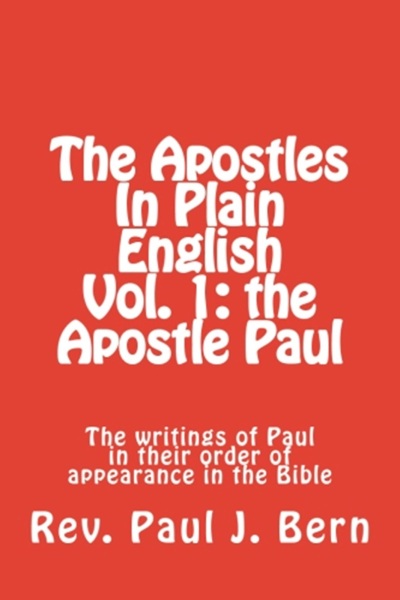
“The Apostles In Plain English Vol. 1: the Apostle Paul” by Rev. Paul J. Bern

An in-depth analysis of the writings of the apostle Paul in their order of appearance in the Bible. Watch the video at https://youtu.be/N4RXD3iOnxI


Contributing To One Another
[Romans chapter 12]
Today in our continuing series of studies of the book of Romans, we move on to chapter 12. In this chapter, the apostle Paul talks about how we can initiate fundamental change for the better from within ourselves. He then explains how this renewal of self can affect our place within the community of believers as well as for the good of everyone else. He then goes on to outline how this personal renewal in Christ for the sake of our relationship with Christ applies to our everyday lives and what we as responsible Christians can do to cause this personal renewal manifest itself. I will begin with verse one.


“Therefore, I urge you, brothers, in view of God's mercy, to offer your bodies as living sacrifices, holy and pleasing to God – this is your spiritual act of worship. Do not conform any longer to the pattern of this world, but be transformed by the renewing of your mind. Then you will be able to test and approve what God's will is – His good, pleasing and perfect will.” (Romans 12: 1-2)


We are to offer ourselves as living sacrifices to God in the same way that Christ offered Himself up on the cross of Calvary. Furthermore, we are to be living in the world while remaining separate from it. We can live here as usual but not be caught up in the materialistic and vain trappings of the world as it currently exists. We can accomplish this by what Paul calls “mind renewal”. This means being a modern Christian requires a new and different way of thinking that sets us apart from the rest of humanity. It is only when we do this that we can find out for ourselves what God's will is for our lives. And His will is always perfect for us whether we realize it or not. And if we don't yet do so, we can still accomplish this by the renewal of our minds in Christ Jesus.


“For by the grace given me I say to every one of you: do not think of yourselves more highly than you ought, but rather think of yourself with sober judgment, in accordance with the measure of faith that God has given you. Just as each of us has one body with many members, and these members do not all have the same function, so in Christ we who are many form one body, and each member belongs to all the others. We have different gifts, according to the grace given us. If a man's gift is prophesying, let him use it to the proportion of his faith. If it is serving, let him serve; if it is teaching, let him teach; if it is encouraging, let him encourage; if it is contributing to the needs of others, let him give generously; if it is leadership, let him govern diligently; if it is showing mercy, let him do it cheerfully. (Romans 12: 3-8)


The first point Paul makes is that there is no room for big egos in God's family. Everyone has a place in God's family “in accordance with the measure of faith that God has given you”. Everyone has a function within God's family, and Paul names these functions without any particular order of importance. Notice that he mentions money only briefly (“if it is contributing to the needs of others, let him give generously”). This is in stark contrast to the erroneous teachings of the modern church, which emphasizes tithing 10% of one's income. This is a teaching that goes all the way back to the Old Testament, well before the time of Christ. As I said in one of my recent Sunday commentaries, we should definitely contribute to churches and other charities as we see fit. However, the harsh economic realities of the modern world in which we live make giving 10% a prohibitively expensive proposition, especially for the poor and middle class. Let the rich give 15% to their churches in our place. Besides, when Jesus died on the cross, the old law was sacrificed with Him and He became the new law. Paul then goes on from there.


“Love must be sincere. Hate what is evil, cling to what is good. Be devoted to one another in brotherly love. Honor one another above yourselves. Never be lacking in zeal, but keep your spiritual fervor, serving the Lord. Be joyful in hope, patient in affliction, faithful in prayer. Share with God's people who are in need. Practice hospitality. Bless those who persecute you; bless and do not curse. Rejoice with those who rejoice, mourn with those that mourn. Live in harmony with one another. Do not be proud, but be willing to associate with people of low position. Do not be conceited.” (Romans 12: 9-16)


The timely advice that is in these few verses is just as relevant now as it was nearly 2,000 years ago when it was first written. Love must be genuine, and never abusive. Stand up to evil and oppose it at every turn. Be a truly selfless person who thinks of themselves last, who puts others first, rarely complaining. Now comes the hardest part, because it's a quote from Christ himself. “Bless those who curse you...”, be kind to those who oppose you or who have personal vendettas. You will be surprised (based on my own experience) at how quickly this tactic can disarm those who oppose you. Be willing to associate with people of low position, such as the homeless. I was once homeless myself for about four months, and I didn't think such a thing could happen to me back then until it did. I'm retired from IT after over 20 years in the computer business. But when you're self-employed and the demand for your product dries up, your income dries up too. Never be conceited, and be wary of all the class warfare that's going on in America. And how do we accomplish this and other similar things, such as our relationship with Christ? By being “transformed by the renewing of our minds”. Paul then continues on with these closing verses.


“Do not repay anyone evil for evil. Be careful to do what is right in the eyes of everybody. If it is possible, as far as it depends on you, live at peace with everyone. Do not take revenge, my friends, but leave room for God's wrath, for it is written. 'it is mine to avenge, I will repay, says the Lord'. (Deuteronomy 32:35) On the contrary, if your enemy is hungry, feed him; if he is thirsty, give him something to drink. In doing this, you will heap burning coals upon his head. Do not be overcome by evil, but overcome evil with good. (Romans 12: 17-21)


As far as it is possible, live at peace with everyone. If any of your enemies refuses to act peaceably toward you, avoid them and don't associate with them. Take it to the Lord in prayer and let God deal with them, and you can be sure that He will. God will deal with your enemies in His good and perfect will according to His perfect timing. That is the way of the Lord, and we are to emulate Him every chance we get. And the peace of God which is beyond all human understanding will be with you all. Let's start putting these teachings into practice on a daily basis. You will be surprised at how much your quality of life will improve, as well as how many doors of opportunity this will open for you. Living God's way through Jesus Christ really is the best way to live our lives. Try it and see for yourself, you will be pleased with the outcome. Enjoy your day! 


Watch the video at https://youtu.be/N4RXD3iOnxI 

Monday, March 26, 2018

Free book excerpt #22 from blogger and author Rev. Paul J. Bern


35a5e-apostlepaul2b1

“The Apostles In Plain English Vol. 1: the Apostle Paul” by Rev. Paul J. Bern

Five years in the making, this first of a series is a lot more than just a compilation of Bible studies. This collection of Paul's writings presents them from a broader perspective that are much more applicable to modern life than one might expect. Each study is limited to a few pages for the sake of brevity. This study of Paul's writings is done from a whole new 21st century perspective that is sure to educate while making the process enjoyable. Over 550 pages of enlightenment! A must-read for believers, whether they attend church or not! An inspirational guide for secular folks too! Watch the video at https://youtu.be/N4RXD3iOnxI


Building On The Foundation Of Christ
[1st Corinth. chapter 3]

This week's Bible study of the writings of the apostle Paul will be on the third chapter of St. Paul's first letter to the church at Corinth. In this passage of Scripture, Paul is teaching about building on the foundation of Christ as a way to avoid divisions within the church, and he is doing so in the context of the state of the early Church at that time. Paul is addressing specific issues that had been brought up previously by this congregation, presumably regarding certain disagreements and arguments that had sprung up among them. In the early part of this chapter Paul finds himself having to rebuke this congregation for their lack of unity due to disputes among them concerning their views on what it meant to be Christian. We will begin at the first verse as usual.


“Brothers, I could not address you as spiritual but as worldly – mere infants in Christ. I gave you milk, not solid food, for you were not yet ready for it. Indeed, you are still not ready. You are still worldly. For since there is jealousy and quarreling among you, are you not worldly? Are you not acting like mere men? For when one says, 'I follow Paul', and another, 'I follow Apollos', are you not mere men? What, after all, is Apollos? And what is Paul? Only servants, through whom you came to believe – as the Lord has assigned to each his task. I planted the seed, Apollos watered it, but God made it grow. So neither he who plants nor he who waters is anything, but only God, who makes things grow. The man who plants and the man who waters have one purpose, and each will be rewarded according to his own labor. For we are God's fellow workers; you are God's field, God's building.” (I Corinthians 3: verses 1-9)


As you can see, Paul is telling the early Corinthian church to grow up, stop fighting among themselves and to quit acting like children in the faith. Paul is admonishing them to become more mature in their faith as God first intended. But he is also saying that it doesn't matter how they first heard the Gospel being preached or from who they heard it. What is important is that the Gospel originates from God, not from mere men. Jesus is the message, and we are the messengers. Paul then refers to a well-known Old Testament verse, “One man plants, another man waters, but it is God who gives the increase”, stating, “...for we are God's fellow workers; you are God's field, God's building”, with another translation of 'building' in this context being 'storehouse' or 'barn'. Paul is saying that all blessings come from God, and He can send even enough to fill up any storehouse. Paul then continues in verse 10.


“By the grace God has given me, I laid a foundation as an expert builder, and someone else is building on it. But each one should be careful how he builds. For no one can lay any foundation other than the one already laid, which is Jesus Christ. If any man builds on this foundation using gold, silver, costly stones, wood, hay, or straw, his work will be shown for what it is, because the Day will bring it to light. It will be revealed with fire, and the fire will test the quality of each man's work. If what he has built survives, he will receive his reward. If it is burned up, he will suffer loss; he himself will be saved, but only as one escaping through the flames. Don't you know that you yourselves are God's temple and that God's Spirit lives in you? If anyone destroys God's temple, God will destroy him; for God's temple is sacred, and you are that temple.” (I Corinthians 3: 10-17)


When Paul says “I laid a foundation as an expert builder”, he is speaking in the context of himself being the founder of the church at Corinth. He then states definitively that anyone building on his foundation had better not use any combustible materials, referring to the Old Testament, which calls God a “consuming fire”. This was written as a warning to the church against the pursuit of material gain and the hoarding of money and goods. This same warning is just as valid to the church today as it was when those words were first written nearly 2,000 years ago. Paul then adds that putting too much faith in our earthly works and treasures won't necessarily prevent us from getting to heaven when we die, but it will be the same as escaping from a fire with nothing but the clothes on our backs. It was also a warning that Christ is the only true foundation upon which the Church is built, and that anything less is impure at best, and heresy at worst. Finally, Paul compares the early church to a new temple of the Lord in which He can dwell, and he reminds us that, “...God's temple is sacred, and you are that temple.” Paul then concludes the chapter beginning at verse 18 by completing his warning to keep the church on the foundation of Christ.


“Do not deceive yourselves. If any one of you thinks he is wise by the standards of this age, he should become a “fool” so that he may become wise. For the wisdom of this world is foolishness in God's sight. As it is written: 'He catches the wise in their craftiness', and again, 'The Lord knows that the thoughts of the wise are futile'. So then, no more boasting about men! All things are yours, whether Paul or Apollos or Cephas or the world or life or death or the present or the future – all are yours, and you are of Christ, and Christ is of God.” (I Corinthians 3: verses 18-23)


To put this into 21st century English, Paul is warning the church, “Don't kid yourselves. People who think they are smart aren't as smart as they would like to think. In the end, everything belongs to God. Anything that is not consumed in His consuming fire, will stand the test of time and be permanent. Everything else is just temporary anyway.” And I believe Paul is telling us these things to make sure we keep our values in perspective, so we can be more spiritual and less superficial. This is a good thing for all of us to put into practice, so let's all start to do this today. That way we'll be able to advance the state of all our lives as we transition into tomorrow.


To buy direct from the author ($19.95) go to http://www.pcmatl.org/#!books-and-donations/c17et


Watch the video at https://youtu.be/N4RXD3iOnxI

Friday, December 22, 2017

Free book excerpt # 17 from author, blogger and Web pastor Paul J. Bern

“The Apostles In Plain English Vol. 1: the Apostle Paul” by Rev. Paul J. Bern (c) 2017 by Rev. Paul J. Bern and CreateSpace.com
 
Five years in the making, this first of a series is a lot more than just a compilation of Bible studies. This collection of Paul's writings presents them from a broader perspective that are much more applicable to modern life than one might expect. 

This study of Paul's writings is done from a whole new 21st century perspective that is sure to educate while making the process enjoyable. Over 500 pages of enlightenment! A must-read for believers, whether they attend church or not! An inspirational guide for secular folks too!

Watch the video at https://youtu.be/N4RXD3iOnxI


The Love Chapter

[1st Corinthians chapter 13]

Today in our continuing study of 1st Corinthians we will cover chapter 13, which is sometimes called “the love chapter” by ministers, Bible scholars, and independent pastors like myself. This 13th chapter is not only a deeply meaningful and eloquent piece of scripture, it has literary beauty as well. The words flow like a gently running stream through a magnificent landscape of cascading spirituality, defining what true love is and how it is shared between ourselves and others in compassionate and tender fashion. Let me begin this lesson at verse one right away. This chapter of 1st Corinthians is so good it won't wait!


“If I speak in the tongues of men and of angels, but have not love, I am only a resounding gong or a clanging cymbal. If I have the gift of prophecy and can fathom all mysteries and all knowledge, and if I have a faith that can move mountains, but have not love, I am nothing. If I give all I possess to the poor and surrender my body to the flames, but have not love, I gain nothing.” (1st Cor. 13, verses 1-3)


When the apostle Paul wrote these words he was not writing about love in a physical sense and he was not commenting on being married vs. remaining single. He was writing about the kind of love that Jesus said we should all have in abundance as He taught us about the two greatest commandments. When asked about this during His ministry, Jesus replied, “These two commandments are that you must love the Lord your God with all your heart, mind, soul and strength, and that you must love your neighbor as yourself. On these two commands rest all the law and the prophets.” And so it doesn't matter what we do for God if we have no love for serving others and do not practice putting them before ourselves as I try to do with this ministry. All the effort in the world will come to nothing if we have no love in our hearts. Paul then goes on to point out the meaning of that statement.


“Love is patient, love is kind. It does not envy, it does not boast, it is not proud. It is not rude, it is not self-seeking, it is not easily angered, it keeps no record of wrongs. Love does not delight in evil but rejoices with the truth. It always protects, always trusts, always hopes, always perseveres.” (1st Cor. 13, verses 4-6)


I could say that this passage is pretty much self-explanatory and move on, but before I do let me comment on what the inverse of this scripture looks like. When Paul wrote that love is patient and kind, he was warning us against being impatient, demanding, unkind and mean. Paul was also telling us that there will be no bullies in heaven. Bullying is completely un-Christian, and this kind of behavior must be opposed in the name of Jesus at every turn. Moreover, when Paul wrote that love is not envious, boastful or proud he was warning us – and the entire Church – against being jealous, arrogant, obnoxious and conceited. When Paul wrote that love is not rude or self-seeking, he was reminding us to be considerate of others while warning us not to be belligerent, controlling or manipulative because such behavior never comes from God. 
 

When Paul wrote that love is not easily angered and keeps no record of wrongs, he was reminding us to control our tempers, to never hold grudges (especially for very long), and to never be abusive towards others for any reason. When Paul wrote that love rejoices with the truth and never delights in evil, he was reminding us that standing against social and economic injustice and the abuse of power is the responsibility of Christians everywhere, as Rev. Dr. King Jr. (who was himself a minister of the Gospel) so memorably reminded us of a generation ago. If love always protects, then it is never negligent nor does it lack diligence. If love always trusts then it is never dishonest. If love always perseveres, then love is relentless, never giving up. Let me now continue our study of this truly beautiful passage of Scripture.


“Love never fails. But where there are prophecies, they will cease; where there are tongues, they will be stilled; where there is knowledge, it will pass away;For we know in part and we prophecy in part, but when perfection comes, the imperfect disappears.” (1st Cor. 13, verses 8-10)


“Love never fails”. Even though the world around us is coming apart at the seams, love will still be standing when it implodes because God, who is eternal, is the personification of love. Even though marriages fail, love will drive men or women to seek another relationship to replace it. Even though our country's unsustainable debt-based economic policies threaten to crash the capitalist financial system straight into the ground (and make no mistake, that is exactly what will ultimately occur), love will still be standing even when your money is no good anymore (and that day is also coming, so take heed). Even though nations go to war, love always rebuilds the population when the war finally ends. And it is love from which we derive compassion and empathy, two more human virtues that similarly never fail.


Before I move on, let me comment briefly on verse 10, “For we know in part and we prophecy in part, but when perfection comes, the imperfect disappears.” Knowing and prophesying in part is an acknowledgment of our one-on-one relationship with Christ Jesus. We know Him through our daily walk with Him, through being in an ongoing state of prayer, and we proclaim his Word because we have read it, understood it and are actively obeying it. We only know Jesus in part because we have never actually seen Him, but our faith in Him makes up the difference. Still, until He returns, we only know Him “in part”. “But when perfection comes, the imperfect disappears”. The word perfection in this verse symbolizes and is used as a synonym for Christ. So when He returns, our imperfect relationship with Him will be made perfect because we will have seen Him and in so doing we will be achieving Spiritual fulfillment. Now that I have analyzed this I will move on and finish this up.


“When I was a child, I talked like a child, I thought like a child, I reasoned like a child. When I became a man, I put childish ways behind me. Now we see but a poor reflection as in a mirror; then we shall see face to face. Now I know in part; then I shall know fully, even as I am fully known. And now these three remain: faith, hope, and love. But the greatest of these is love.” (1st Cor. 13, verses 11-13)


Paul is comparing maturing from a child to an adult to our growth in faith in Christ as we are first transformed from lost nonbelievers to born-again Christians and then subsequently becoming ever stronger in our walk with our Savior. As of now, we can only hope to emulate Jesus as best as we can, and we freely choose to believe in Him and to uphold the sacredness of His name even though we have never seen Him. But one fine day we shall all see Him face to face, and we will all instantly recognize Him. Now I know in part; then I shall know fully...; our journey as Christians does not end until we are with Jesus in heaven in New Jerusalem, to dwell with Him forever.


Love is the greatest virtue, it has no equal and thus reigns supreme because its source is from God, a supreme being. True Christian love is unconditional, with nothing held back. It is not selfish or egocentric, it is not used cynically to manipulate or control people, nor is it given in exchange for anything, but instead it is distributed freely and always without expecting anything in return. The three greatest virtues as Paul names them are faith, hope and love – but “the greatest of these is love”. Jesus said in the gospel of John, “A new command I give you, that you are to love one another”. If we just focused all our energy on this one thing, the world would quickly become a far more enjoyable and much safer place to live. And that's a worthwhile goal anytime.


Buy direct from the author ($19.95) at http://www.pcmatl.org/#!books-and-donations/c17et 


Watch the video at https://youtu.be/N4RXD3iOnxI
Happy holidays from Rev. Paul J. Bern 

Monday, October 2, 2017

Free book excerpt #12 from Web pastor and Progressive Christian author and blogger Rev. Paul J. Bern

"The Apostles In Plain English Vol. 1: the Apostle Paul” by Rev. Paul J. Bern

Find out more by clicking here


Which Is Better, Being Lawful Or Being Faithful?

[Galatians chapter 3, verses 1-14]


As we begin this week's study we'll be looking at the first half of Galatians chapter three. In it the apostle Paul continues to take the church at Galatia to task because of certain heretical teachings that were going on at the time. Newly converted Gentile Christians were intermingling with newly converted Jews who embraced Christ as the Jewish messiah. Evidently the non-Jews were being instructed by unnamed Jewish converts to practice and live their new faith while also adopting the Jewish customs of their new brethren in Christ Jesus. Paul continues with his blistering criticism of this practice as we begin at verse one.

“You foolish Galatians! Who has bewitched you? Before your very eyes Jesus Christ was portrayed as crucified. I would like to learn just one thing from you: Did you receive the Spirit by observing the law, or by believing what you heard? Are you so foolish? After beginning with the Spirit, are you now trying to attain your goal by human effort? Have you suffered so much for nothing – if it really was for nothing? Does God give you his Spirit and work miracles among you because you observe the law, or because you believe what you heard? Consider Abraham: 'He believed God, and it was credited to him as righteousness'. [Genesis 15:6] Understand, then, that those who believe are children of Abraham. The Scripture foresaw that God would justify the Gentiles by faith, and announced the Gospel in advance of Abraham: 'All nations will be blessed through you'. [Genesis 12:3] So those who have faith are blessed along with Abraham, the man of faith.” (Gal. 3, verses 1-9)

Here we see Paul summing up his point in one sentence when he wrote, “Did you receive the Spirit by observing the law, or by believing what you heard?” Since the observation of the Law of Moses – the first five books of the Old Testament – was fulfilled by the supreme sacrifice of Jesus Christ, Paul is simply stating that to continue observing the Old Law and its customs is both pointless and unnecessary. The crucifixion, death and resurrection of Christ is the embodiment of the new law, replacing the old. After spending all the time converting them and teaching them and founding a church, Paul is clearly exasperated with the church at Galatia because they had strayed from what he taught them was the Spiritual foundation of that church, none other than Jesus himself. It is not possible to obtain salvation through Christ by our good works alone, although it is good that we all do so whenever and wherever we can. We can do so only two ways according to Scripture; the first is by maintaining a totally committed faith in Christ and his Salvation, and the second is by grace that God bestows upon us through his Son. Grace is defined as unmerited favor, the spiritual equivalent of a free pass. Even though none of us deserves it due to our sins, grace is given to us freely as a token of God's love for us when we accept Jesus as your Lord and Savior. So if you ever need evidence that God really does love you, just think about His grace as you bask in its warm light. If you are already a believer, just focus on that in your mind. And if you aren't yet a believer, now would be a good time to become one. Simply ask Jesus to come and live inside your heart, and to stay there forever.

The other thing the apostle Paul explains (or more likely reiterated) to the church at Galatia is the concept of unity between Jew and Gentile when he wrote, “Understand, then, that those who believe are children of Abraham. The Scripture foresaw that God would justify the Gentiles by faith”... Paul is clearly citing this as another reason to put away the traditions of old and replacing them with the then-new concept of Jesus Christ as the Jewish and Gentile messiah and as the Son of God. If any of you read my studies on the book of Romans, Paul touched on that same topic when he wrote, “For you did not receive a spirit that makes you a slave again to fear, but you received the spirit of Son-ship. And by him we cry, 'Abba, Father'. The Spirit himself testifies with our spirit that we are God's children. Now if we are children, then we are heirs – heirs with God and co-heirs with Christ ...” (Romans 8: 15-17) So you see, Paul was literally telling the Galatian congregation that they were already adopted into the family of God, and that there was nothing extra or special that they needed to do to join the family. Moreover, since our adoption into God's eternal family is through Jesus Christ, whose lineage can be traced all the way back to God, that makes us all Jewish by adoption just as it says in Romans. I don't know about you, but I find the prospect of being an adopted Jew quite appealing. If that is the genealogy of my Lord and Savior, then that is good enough for me. Let's continue now and conclude today's study beginning at verse ten.

“All who rely on observing the Law are under a curse, for it is written: 'Cursed is everyone who does not continue to do everything written in the Book of the Law.' [Deut. 27:26] Clearly no one is justified before God by the Law, because 'the righteous will live by faith'. [Habakkuk 2:4] The Law is not based on faith; on the contrary, 'The man who does these things will live by them'. [Lev. 18:5] Christ redeemed us from the curse of the law by becoming a curse for us, for it is written: 'Cursed is everyone who is hung on a tree.' [Deut. 21:23] He redeemed us in order that the blessing given to Abraham might come to the Gentiles through Christ Jesus, so that by faith we might receive the promise of the Spirit. (Galatians 3, verses 10-14)

The apostle Paul repeatedly quotes the Old Testament – or more accurately the Law of Moses, which was still very much the religious tradition of that time in that part of the world – in order to finish making his point. Paul's literacy was the exception rather than the rule in those days, and he uses his educational level to his advantage right here. Clearly, Paul writes, “ … no one is justified before God by the Law, because 'the righteous will live by faith'...”. This is the crux of the matter, which is that no one can enter into God's kingdom – or the third heaven, as Paul called it – based on their good deeds and legalistic achievements. The only way to salvation is through our uncompromising and undiluted faith in the saving power of the blood of Christ. There is no other way by which any of us may enter heaven, and there are no exceptions allowed based on the teachings of Christ. If anyone tries to tell you any different, get away from those people and those churches because they are teaching a false doctrine, and they will be held accountable. But it is the truth, Jesus said, that will make you free, and anyone who is free in Him is truly and irrevocably free. And that's the best news of all.

Buy the print version direct ($27.95) from the author here
Also available in audio format exclusively on Amazon (click here)
Get the Kindle version from here
Get it on Smashwords.com (Apple, Kobo, etc.) from here
Watch the video at https://youtu.be/N4RXD3iOnxI

Friday, August 18, 2017

Free book sample #8 from Pastor Paul J. Bern -- from my newest release!

“The Apostles In Plain English Vol. 1: the Apostle Paul” by Pastor Paul J. Bern
To watch a short video about the book, click here


Preparing Ourselves For the Day of the Lord
[1st Thessalonians chapter 5]

When I closed out 1st Thessalonians chapter four last week, you no doubt recall my interpretation that we are to be living each day of our lives as if it will be our last. I cannot overemphasize this important truth, nor is it possible to diminish its importance. God is watching everything we do and listening to everything we say, and for a man like myself being in a position of Christian leadership, I am held to a higher standard by the Lord, because what applies to church members applies to me twice as much. Plus, as our Lord's return for his Church continues to get ever closer, I fervently hope that others will follow my example and be continually readying themselves for His coming. And this, my dear readers, is a goal worth attaining at any time. It is at this point that the apostle Paul takes up where he left off, starting at the beginning of chapter five.

“Now, brothers, about times and dates we need not write to you, for you know very well that the day of the Lord will come like a thief in the night. While people are saying 'Peace and Safety', destruction will come on them suddenly, as labor pains on a pregnant woman, and they will not escape. But you, brothers, are not in darkness so that this day should surprise you like a thief. You are sons of the light and sons of the day. We do not belong to the night or to the darkness. So then, let us not be like others, who are asleep, but let us be alert and self-controlled. For those who sleep, sleep at night, and those who get drunk, get drunk at night. But since we belong to the day, let us be self-controlled, putting on faith and love as a breastplate, and the hope of salvation as a helmet. For God did not appoint us to suffer wrath but to receive salvation from our Lord Jesus Christ. He died for us so that, whether we are awake or asleep, we may live together with him. Therefore encourage one another and build each other up, just as in fact you are doing.” (1st Thessalonians 5, verses 1-11)

Paul paints a vivid picture of the coming of the Lord. Of course, one might ask if this is pertaining to the rapture of the church, or to the Lord's triumphant return three and a half years later (see the Book of Daniel chapter 12, etc). If you are one of those who has studied the rapture, the tribulation and the signs that we are living in the end times (never mind what you may have seen on TV or at the movies), then it is essential that we understand what Paul meant here. When he wrote, “the day of the Lord will come like a thief in the night”, I believe this warning was meant primarily for the Church. Be ready, watch and pray that we receive purification from the Holy Spirit, so that as members of the Bride of Christ we may be found “without spot or blemish”.

“While people are saying 'Peace and Safety', destruction will come on them suddenly...”. According to prophecy, before the Antichrist can come to power, World War 3 will have to occur first (also known as the Gog-Magog war of Ezekiel 39 and 39). There will also have been a series of natural disasters that will have occurred by this point in time (I don't have time to explain that part in detail, so please bear with me). People will be clamoring globally to be free to live in peace, and to be safe from natural disasters; “... and they will not escape” can be translated into modern English as saying, “Total destruction will overpower them without warning, and they won't stand a chance”. Nobody knows exactly what this means since all those other events have not yet occurred, and speculation would be counterproductive. All I can tell you is that the Antichrist will be in power for a total of seven years, and that one of his first acts will be to negotiate the peace treaty that ends World War 3. All the countries involved will adhere to this peace agreement for three and a half years. At that point the Antichrist will do something that breaks that same peace deal while elevating himself to something supposedly equivalent to God, as if there were such a thing. It is at this point that the persecution of Christians will greatly increase, and this will be happening in the US as well. This will be the “acid test” for all of those who identify themselves as being Christians. Either we take the mark of the beast and worship the Antichrist as god here on earth, or we refuse and continue to worship Jesus as the Son of God in heaven. Those who do worship Jesus will find themselves being martyred by the forces of the Antichrist. A time is coming when our Christianity will cost us our life. What will you choose? To quote the prophet Jeremiah, “As for me and my household, we will serve the Lord”. Since the Lord died on the cross for my sins, I would not have any problem returning the favor, knowing that like himself, he will raise me from the dead to eternal life. We should all be willing to do the same.

“But you, brothers, are not in darkness so that this day should surprise you like a thief. You are sons of the light and sons of the day. We do not belong to the night or to the darkness. So then, let us not be like others, who are asleep, but let us be alert and self-controlled.” Remember who we are in Christ! We are the adopted sons and daughters of the Most High God through the shed blood of Jesus Christ. We were bought at a very steep price, one that no man would be willing to pay. We were adopted as sons and daughters of Jesus our Kinsman Redeemer, making all of us Jewish by adoption (see Romans 8: 15-17 or Galatians 4: 4-7, among others). We don't belong to the night and we never did, we were born for the day and for the light from our very conception. “Let's be alert and self-controlled”, Paul wrote. You won't be ready to meet the Lord at the rapture if you're in bed sleeping off a hangover, or after playing video games all night long. As I have said before, it's time for us all to get our priorities straight. Jesus first, worship him first and always give him top priority in your daily living and you'll find yourself living with an internal peace that was neither present nor possible before. I'm speaking from experience, and if God can do this for me then he can do so for you too. But we must ask Him first. Sitting around waiting for God to give any of us a hand-out will accomplish nothing, unless one considers wasting time an accomplishment. I most definitely don't!

“ God did not appoint us to suffer wrath but to receive salvation from our Lord Jesus Christ. He died for us so that, whether we are awake or asleep, we may live together with him. Therefore encourage one another and build each other up...”. I will sum this up in one sentence – we're not here to be on the receiving end of the tribulation that Jesus spoke about, but rather we will be protected from it if only we remain faithful to his Word. “If you love me”, Jesus said, “keep my commandments”. Jesus died so that we may have eternal life with him in heaven, a new dwelling place that we have not yet seen. Obeying His commandments is the second prerequisite, believing that he is the Son of God is the first. Having written that, let's conclude our study starting at verse twelve.

“Now we ask you brothers, to respect those who work hard among you, who are over you in the Lord and who admonish you. Hold them in the highest regard in love because of their work. Live in peace with each other. And we urge you brothers, warn those who are idle, encourage the timid, help the weak, be patient with everyone. Make sure nobody pays back wrong for wrong, but always try to be kind to each other and to everyone else. Be joyful always; pray continually; give thanks in all circumstances, for this is God's will for you in Christ Jesus. Do not put out the Spirit's fire; do not treat prophecies with contempt. Test everything. Hold on to the good. Avoid every kind of evil. May God himself, the God of peace, sanctify you through and through. May your whole spirit, soul and body be kept blameless at the coming of our Lord Jesus Christ. The one who calls you is faithful and he will do it. Brothers, pray for us. Greet all the brothers with a holy kiss. I charge you before the Lord to have this letter read to all the brothers. The grace of our Lord Jesus Christ be with you.” (1st Thessalonians chapter 5, verses 12-28)

Respect the value of hard work, Paul is saying, and especially those who do so. Dirty hands and sweat can turn an otherwise boring day into a really fun one. This is especially true of the younger men and women who are still able-bodied enough to do so (unfortunately, that is no longer the case with me). Hard physical work is dignified provided that it is done constructively. “Warn those who are idle, encourage the timid, help the weak, be patient with everyone.” Build each other up, don't tear each other down! Make the idle people either get off their butts and get to work or move on and stop standing in the way. It is written in the law of Moses, “If a man will not work he shall not eat”. Yet by the same token we are commanded to “be patient with everyone”. Give the slower people a chance to catch up. Better yet, why not donate your time and tutor a few to help them along? Now that would be in keeping with the Holy Spirit of Christ!

“ ...always try to be kind to each other and to everyone else.” Sometimes I think the secular world understands this better than modern churches do today. Immediately after recent natural disasters here in America, there were armies on volunteers that descended on these devastated areas and helped clean up, doing whatever needed to be done. What surprised me was when I found out that up to half of these volunteers don't bother going to church. Yet they understood the command and answered the calling that God obviously put on them. “Do not put out the Spirit's fire; do not treat prophecies with contempt. Test everything. Hold on to the good. Avoid every kind of evil.” Let the Holy Spirit always be in control of everyone, every life, in every situation and in all circumstances. Check out everything you see, hear or read to determine its value, or the lack thereof. Put problem people completely out of your life if that's what it takes to get free from negative influences and all forms of evil. Hold on to the good and simply let everything else go. Such timeless wisdom!

“May your whole spirit, soul and body be kept blameless at the coming of our Lord Jesus Christ. The one who calls you is faithful and he will do it.” Paul closes out by replaying that theme of being found holy and blameless before the Lord, with the understanding that this is only possible through the indwelling of the Holy Spirit. No one can do this by themselves, but only through complete reliance on the Holy Spirit can such a noble goal as this be achieved. The key is in the last sentence, “The one who calls you is faithful and he will do it.” Total reliance on Christ will enable him to cause us to be holy, pure and blameless in the sight of God. Instead of being self-reliant as we are in most situations, we are to step aside and let Christ do the work, not for us but through us as we become willing conduits for his unequaled Spiritual power. That is the ultimate meaning of unity through Christ. Shalom!

Available in print at
Get the Kindle version by clicking here 
Or, get it for Apple/Mac or Kobo.com from here
Get the audio version on Amazon Audible from here
Many thanks to all!

Sunday, May 25, 2014

What should law abading citizens do when those in authority are criminals?

Submission To Authority: Pro And Con
by Rev. Paul J. Bern


Here in the early 21st century, we live in a world where authority has gotten completely out of control. America was lied to back in the early 1960's so our government could start the Viet Nam war. We were lied to about President Kennedy's assassination by the Warren Commission, and we were lied to again five years later concerning the Robert Kennedy assassination. We were lied to about Rev. Dr. King's assassination that same violent year of 1968. President Nixon lied to us about Watergate. We were lied to in 2003 as a pretext for invading Iraq the second time. And we were lied to by president Obama when he won the 2008 election while telling us all that he would bring us “change we can believe in”. We got some serious changes all right, resulting in the largest spy and unmanned drone network the world had ever seen. On the home front, the police have become thoroughly militarized, and they are having lots of fun on the job thanks to all their new toys and gadgets, not to mention fully automatic weapons, and even tanks! They can stop you and search you without cause and without the Constitutionally mandated search warrant. They are breaking our doors down in the middle of the night and murdering unarmed citizens. A 92-year-old woman was shot 19 times and killed by the police several years ago right here in Atlanta where I live and work, and people of color as well as the poor are being killed by the police on the flimsiest of pretexts. Last year when I tried to renew my drivers license, I was turned away due to a speeding ticket I got back in 1995 even though I paid the fine nearly two decades ago. So now I no longer own a car, but I'm saving a lot of money by relying on public transportation and “going green”. Still, the state of Georgia's refusal to renew my drivers license makes me feel resentful and disenfranchised by the very system that is sworn to protect me and to serve us all.


Speaking as a minister of the Gospel and as an ambassador for Jesus Christ, I have done a little research as to what the Bible says about governmental authority and the abuse of power. It turns out that there is ample argument that can be minted for both sides of this same coin. The first part has to do with submission to authority in the context of being a law-abiding citizen as the apostle Paul saw it when he wrote the Book of Romans approximately 1,950 years ago. At the time that this was written, all of what is now modern-day Israel was under the military occupation of the Roman empire. Similarly, much of the world today is occupied by the American Empire. Paul wrote these words in that context, so I will begin with the book of Romans, chapter 13 and verses 1-5.


“Everyone must submit himself to the governing authorities, for there is no authority except that which God has established. The authorities that exist have been established by God. Consequently, he who rebels against the authority is rebelling against what God has instituted, and those who do so will bring judgment on themselves. For rulers hold no terror for those who do right, but for those who do wrong. Do you want to be free from fear of the one in authority? Then do what is right and he will commend you. For he is God's servant to do you good. But if you do wrong, be afraid, for he does not bear the sword for nothing. He is God's servant, an agent of wrath to bring punishment on the wrongdoer. Therefore, it is necessary to submit to the authorities, not only because of possible punishment but also because of conscience.” (Romans 13: 1-5 NIV)


At the time that Paul wrote this, the death penalty was commonplace. Capital punishment existed as a means of intimidation and absolute control, and that punishment was carried out with utter ruthlessness and without mercy. Furthermore, unlike the Jewish religious establishment of that era, Paul was a Roman citizen and as such he was given rights and privileges that were not shared equally with other non-citizens. But how does this compare with life in the early 21st century? Although the death penalty is still administered for capital crimes such as murder, it is carried out with relative infrequency compared to the days of the Roman empire. There were also debtors prisons in Paul's day. People who ran into financial trouble back in those days were routinely imprisoned until their debts were paid. In contrast, today if one gets into financial difficulty, bankruptcy laws exist that are much more fair and equitable than prison. Compared to the times in which St. Paul lived, we get a complete picture of a much more fair, equitable and even lenient world in the present day. Let me now make some comparisons between Paul's world and ours using this passage of scripture as a backdrop to the picture that I will now paint for you with my words.


“The authorities that exist have been established by God”. Although Paul sincerely believed at the time that he wrote these words that he was absolutely correct, he was speaking more as a Roman citizen and a Hebrew religious scholar than he was as a minister of the gospel of Jesus Christ. In modern America, our rule of law is the Constitution of the United States and so I am writing today in this context as an American citizen. We have the right to free speech and freedom of religion today that did not exist in St. Paul's time. That right which is established under the first amendment to the US Constitution allows me to write these words without fear of punishment. As such I am within the law and I will remain so for as long as the law is fair. It's when it's unfair that things can get a bit dicey. But hold that thought as I continue.


The apostle Paul continues with this same theme as he writes further: “Consequently, he who rebels against the authority is rebelling against what God has instituted, and those who do so will bring judgment on themselves. For rulers hold no terror for those who do right, but for those who do wrong.” The same applies today. Take the patriot movement and so-called “preppers” of today. Organizing any armed revolt in modern-day America is an idea that I am against, preaching and teaching as a man of peace who tries his best to emulate Jesus, the Prince of Peace. Besides, the police have well-armed SWAT teams, and there is always the National Guard that exists within any given state, and so I think one would be foolhardy to try and take on authority in this manner. On the other hand, it is perfectly legal, and I would also say that it is even necessary, to engage in peaceful protests against laws and policies that we disagree with, particularly when they are unjust. The US Supreme Court's decision that money equals free speech is one good example. The counterproductive and sometimes downright stupid War on Drugs is another one. The first amendment gives us this right, something that did not exist during Paul's time all those centuries ago. In this regard, we can interpret this passage of scripture a little differently than what Paul wrote back then.


Paul then continues making his point, and so will I. “Do you want to be free from fear of the one in authority? Then do what is right and he will commend you.” It is sad to say that this is not always true in the modern world. Trying as I do to do what is right, I often find myself looked down on by the many godless people who live in the world of today. I put up with the occasional ridicule because I am openly Christian, but I do so knowing that God is watching everything I do and He is listening to everything I say. But to get back to the topic at hand, it is wise to be “free from fear of the one in authority”. The best way to follow this principle is to obey the commandments and the teachings of Jesus Christ. Just by doing this, we can keep ourselves out of much trouble. Besides, the Bible says in the Old Testament to “obey the laws of the land, that it may go well with you in the place you are abiding”. Those words were written at least three thousand years ago, and they are still just as true today as they were back then.


By the same token, there are things happening and situations unfolding within the US government that are completely contrary to God's laws. Take the ten commandments as an example. The eighth commandment says, “You shall not bear false witness against your neighbor”, which can be expanded to include this simple command: you shall not lie and gossip about people you dislike. Yet America found itself embroiled in a war in Iraq that was based on a lie. Specifically, that there were weapons of mass destruction in Iraq when Saddam Hussein was still in power. Of course, those WMD's turned out to be non-existent, and it took 4,400 US fatalities – and over 100,000 Iraqi civilian deaths, one third of which were children – to find that out. The same applies to Afghanistan. Our troops have been there for 13 years, first to find Osama Bin Laden even though everybody in Southern Asia and the Middle East knew he was in Pakistan. Now that he is deceased, and has been for a couple of years now, are our troops all back home yet? Absolutely not, effectively making Afghanistan a de facto US territory with an open ended US military presence. The US government has been spending $6 billion dollars a week on this occupation, a thoroughly obscene sum of money by any standard. Yet all the while, there is unemployment here in the USA that is officially around 7.5%, but that doesn't count all the millions of long-term unemployed who have stopped looking for work, as well as those who are working part-time when full-time work is what is needed. If these facts were figured into this equation, the true unemployment rate is hovering at around 21 percent. There is no money to create over a million badly needed jobs in our country, but there is an unlimited supply of cash for multiple illegal military occupations and drone strikes all around the globe. This is a moral outrage, and anybody with even a little bit of a conscience should be out in the streets protesting against the US military-industrial complex. That may not be in the words of the Bible, but it most certainly is in the Spirit thereof.


Paul then writes in verse 5, “Therefore, it is necessary to submit to the authorities, not only because of possible punishment but also because of conscience.” This is just as true today as it was when it was first written. Being an outlaw will only get us into trouble, and jail is no place for anybody to be except for the worst criminals. For example, it is a bad idea to drive your car at 90 miles an hour because it is against the law, and because it is dangerous. By the same token, the ten commandments must be obeyed, and let's be sure to include the teachings of Christ while we're at it. We should not steal, lie or commit adultery, nor should we have any false gods in our lives. We are commanded to “love the Lord your God with all your strength, all your mind, all your soul and all your spirit”, and to “love our neighbor as we love ourselves”. We can and should worship the one true God and Him alone, who sent His only Son to die for our sins and then to rise from the dead on the third day after He was crucified. In the same way that we submit ourselves to God, we should, as far as it is possible, submit to authority here on earth. And we should do so not only “because of possible punishment but also because of conscience”. But here in the 21st century, we can and should oppose and protest against the government similarly because of matters of conscience. It is part of the laws of our land, and we should exercise this right because our rule of law says we can. This is also in keeping with God's commands, and I hope and pray that it always remains so.